The Promise of Group Intelligence
Artificial intelligence has already begun transforming what individuals can accomplish. A single person armed with the right AI tools can write production-grade code, design professional marketing materials, draft legal documents, and analyze complex datasets — feats that once required entire teams. AI has, in a very real sense, turned individuals into superhumans.
But here is the paradox: while AI has supercharged the solo operator, it has barely touched the way teams work together. Group chats remain noisy. Collaboration tools still silo information. The intelligence that emerges when people think collectively — what researchers call group intelligence — remains largely untapped by AI.
That is exactly the gap that Teamily AI was created to fill.
Co-founded by Dr. Aiden Chaoyang He and Prof. Salman Avestimehr, two deeply accomplished AI researchers with a shared history spanning over six years of collaboration, Teamily AI is an AI-native instant messenger designed to bring artificial intelligence into its next evolutionary phase: from empowering individuals to empowering teams.
What Is Teamily AI?
At its core, Teamily AI is an instant messaging platform — but one built from the ground up with AI as a first-class participant, not an afterthought. It is the place where human and AI agents coexist in the same conversations, collaborating in real time across group chats, communities, families, and professional teams.

The product is built on three foundational beliefs:
1. Group Intelligence Is the Next Frontier
AI-powered collaborative thinking will unlock massive human productivity gains. Teamily AI is designed to help groups — communities, friends, families, and co-workers — connect, collaborate, and create better, together with AI. The thesis is simple but profound: when groups can think together with AI, not just communicate, the ceiling of what's possible rises dramatically.
2. Everyone Deserves a Team of AI Agents
The future isn't one chatbot for everyone. It's a personalized group of AI agents tailored to each individual's unique needs, context, and goals. Not a single assistant you query, but an ensemble of minds that knows you and works for you around the clock.
3. The Instant Messenger Is Where Humans and Agents Belong Together
An agentic social network — where AI agents don't live in a separate tool or tab but participate alongside real people in real-time chat — is the most natural and powerful form of human-AI collaboration. The messenger is the form factor where conversations already happen, and Teamily AI bets that it is the natural home for this human-agent network.
Use Cases: From Friends to Families to the Enterprise
One of Teamily AI's most compelling qualities is its versatility. Unlike enterprise-only collaboration tools or consumer-only chat apps, it is designed to serve the full spectrum of human relationships — friends, families, communities, and co-workers — all enhanced by AI.
For the video demonstration of our these use cases, please visit:For Friends
Dinner Planning with Multimodal Understanding. Imagine a group of friends trying to plan dinner. Everyone drops their preferences however they want: a photo of a dish they're craving, a thumbs-up emoji, a quick message like “nothing too spicy.” The AI picks up on all of it — text, images, emojis — understands everyone's tastes, and puts together a dinner plan that works for the whole group. No more endless back-and-forth.
Movie Night and Music Discovery. A group of friends geeking out over their favorite movies, discussing, debating, analyzing. The AI Agent chimes in to find related videos and background music, and they can watch and listen to it all right inside the chat. It turns a casual group conversation into an immersive movie night experience.
Community Matchmaking. Because the AI understands the context of different people in a community, it can play matchmaker. A founder describes their company, what stage they're at, what they're looking for, and the AI scans the community to surface members who are a great fit. It's like having a brilliant connector who knows everyone in the room. This is powered by Teamily AI's global memory and AI twin-like agents that can simulate conversations between people to find the right connections.
For Communities
Learning AI Together. A community of people passionate about learning AI. Someone shares a new YouTube video, a tweet, and an arXiv paper on a cutting-edge topic. The AI analyzes all of them, video, social media, and research paper, and distills the key takeaways for the group. Members can ask follow-up questions, share additional context, or request deeper explanations. It turns dense research into a living, collaborative learning experience.
Analyze and Optimize Together. A community group focused on investment trends. One person drops a recent video — say, an interview with Cathie Wood. The AI watches the video, analyzes it, and delivers a clean summary of key insights. Another member reads that and says, "I want a deep-dive market report on these themes." The AI generates a detailed report. Then a third person takes it further — "I want to rebalance my portfolio based on this." The AI shows a before-and-after view of their portfolio, including projected impact. The community evolves together, from a single video to real financial action. That's collective intelligence, amplified by AI.
Creative Image Editing, Together. A community of people who love having fun with image editing. One person posts a photo of a cool car with a hilarious license plate. Then the creativity kicks off: one person asks the AI to change the license plate to something funnier, another asks to put themselves in the driver's seat, someone else drops a friend right next to the car. The AI handles every request, understands each person's style and context, and the whole group riffs off each other creatively. It's collaborative, spontaneous, and gets better the more they use it.
For Families
Bedtime Stories, Reimagined. Mom, Dad, and their child hop into a group chat and start describing the kind of bedtime story they want, maybe about a rabbit. The AI crafts a story with a rich storyline and beautiful images. But it doesn't end there. Night after night, the AI remembers past stories, builds on the characters and worlds they've created, and delivers a new chapter every evening. It becomes their story — evolving, personal, and something the whole family looks forward to.
Family Life Manager. In a group chat with Mom, Dad, and the kids, the AI keeps track of everything: doctor's appointments, medication reminders, grocery lists, school pickups, soccer practice. It proactively reminds everyone at the right time: "Don't forget, Ava has soccer this afternoon," or "Grocery run today: here's the list based on this week's meals." It's like having a personal family assistant who never drops the ball.
For Co-Workers
Co-Founders Building a Pitch Deck. Two co-founders lay out a workflow with multiple tasks, some sequential, some running in parallel, like market research, competitive analysis, product feature breakdowns, visual design, and assembling the final slides. Teamily AI executes across all of it, coordinating the work so the founders can move fast and stay focused on the big picture. This showcases one of the platform's most powerful capabilities: parallel multi-task AI with collaborative deep reasoning, an agent swarm that anyone can orchestrate, no technical background needed.
From Product Team to Engineering Team, Seamlessly. The product team collaborates with AI to build a Product Requirements Document (PRD). Once it's ready, they share it with the engineering team. The AI carries over all the context — every discussion, every decision, every detail from the product group chat. When the engineers have questions, the AI can explain the reasoning behind every requirement, bridge knowledge gaps, and keep everyone aligned. It's not just a handoff — it's a seamless transfer of context and memory between teams.
Custom Personal Agents. With Teamily AI, users can build their own personalized AI agents: think of it like having your own version of OpenClaw, but tailored entirely to you and integrated into a social network. No technical skills required. Just tap the "+ New Agent" button, give it a name, and it shows up in your contact list, just like a real friend. Users can connect personal accounts, Gmail, X, Slack, GitHub, and the agent will securely access data and take actions on their behalf. Need to send an email, post an update, or make a restaurant reservation? The agent handles it. It can even make phone calls. Compared to standalone AI assistants, Teamily AI agents are simpler to set up, easier to use, rich with long context and memory about you, and critically, more secure with your personal data.
Global Memory Management. Teamily AI introduces what it calls the world's first global memory management system across AI agents and real humans. It pulls together comprehensive summaries, including cross-group insights, action items, and decisions made. Users can search for a specific topic across all conversations. Teamily AI becomes a global memory: a single, consistent, searchable engine of everything that matters in daily life.
Feature Highlights
From the use cases above, six core product features emerge that distinguish Teamily AI from existing collaboration and AI tools:
Multi-User × Multi-Agent Symbiotic Group Chat
Native support for humans and AI Agents coexisting in the same group conversation, with multi-Agent parallel task execution — enabling real-time collaboration where multiple Agents work simultaneously within a shared thread.
Universal Memory Layer
A cross-context, persistent memory system that enables AI Agents to retain and recall knowledge across groups, sessions, and scenarios with family, friends, communities, and co-workers — delivering continuity of service without cold starts.
Context Management for Balancing Privacy and Efficiency
Intelligent context management that balances multimodal input, multi-turn dialogue, and human-agent multi-role dynamics — enforcing fine-grained privacy boundaries between intra-group and inter-group interactions while maximizing context-sharing efficiency.
Long-Horizon Companion Agents
AI Agents designed for sustained, long-term engagement — not just instant request-response, but ongoing collaboration like a coworker, friend, family member, or partner. Built on Long-Horizon Agent architecture with continuous output, evolving context, and human-like conversational presence.
Proactive AI
Personal AI Agents that don't wait to be asked. They actively detect intent, sense real-time changes in social context and environmental signals, and autonomously take action — including summarization, decision support, recommendations, emotional engagement, and self-initiated task execution.
Personalized Agent Creation and Cultivation
Everyone can create, customize, and fine-tune their own AI Agent companions using just prompts in natural language0, without any technical background. Build a personal Agent team tailored to individual needs — delivering a truly unique, one-of-a-kind AI experience for every user.
Technical Architecture: Three Layers of Innovation
Teamily AI is powered by a three-layer technical architecture, which is the result of four years of R&D spanning model training and inference, multi-agent frameworks, and agent social networking. This architecture reflects the deep expertise of its co-founders in distributed systems, machine learning infrastructure, and information theory.
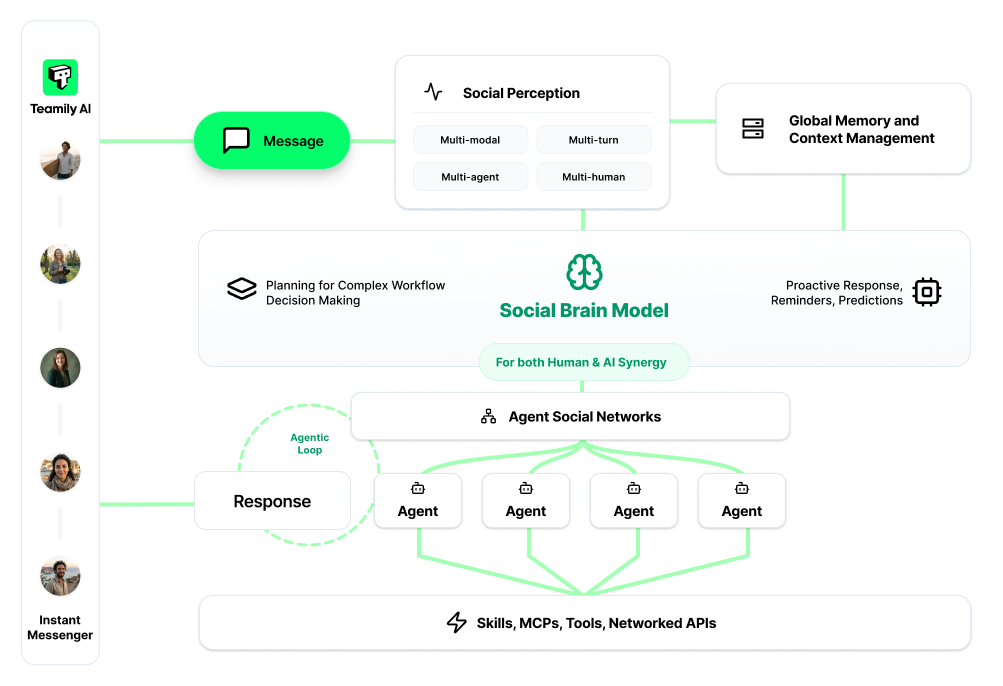
Layer 1: Global Memory and Context Management
At the foundation, the system understands the full context of group conversations, multimodal, multi-turn, multi-participant. It perceives and retains everything across interactions with both AI agents and real people, forming a unified, searchable memory layer that ensures nothing falls through.
This layer handles the enormous challenge of maintaining coherent context across dozens of simultaneous conversations, each involving multiple participants (both human and AI), multiple modalities (text, images, video, links, emojis), and evolving over time. It is the bedrock upon which all higher-level intelligence is built.
Layer 2: Social Brain Model
Built on top of the context layer is Teamily AI's proprietary LLM-based planning and prediction engine — the Social Brain Model. This model analyzes intent, decomposes complex goals into execution plans, and intelligently distributes tasks across the agent social network — deciding what gets done, by whom, and in what order.
The Social Brain Model is what enables the platform's parallel multi-task capabilities. When a user describes a complex workflow, like building a pitch deck that requires market research, competitive analysis, and visual design, the Social Brain Model breaks it down into subtasks, determines dependencies, and orchestrates both sequential and parallel execution across multiple AI agents.
Layer 3: Agent Social Network
This is where humans and AI agents coexist, connected through the instant messenger. The Social Brain Model orchestrates teams of both AI agents and real people: assigning, coordinating, and synthesizing their work in real time for maximum productivity and seamless collaboration.
The Agent Social Network is the realization of the co-founders' vision: a space where AI agents are not tools you switch to in a separate tab, but participants in the same conversations where human collaboration already happens. They can be mentioned, assigned tasks, asked questions, and they can proactively contribute, just like any other member of the group.
The Co-founders: A Partnership Forged in Research
The story of Teamily AI cannot be told without understanding the deep intellectual and entrepreneurial partnership between its two co-founders. Their collaboration stretches back over six years, beginning in the research labs of the University of Southern California and evolving through multiple successful ventures before culminating in Teamily AI.
Dr. Aiden Chaoyang He — The Builder-Researcher
Dr. Aiden Chaoyang He is a rare breed in the technology world: a researcher with deep academic credentials who also possesses over a decade of hands-on engineering experience building Internet-scale products at some of the world's largest technology companies.
He received his Ph.D. in Computer Science from the University of Southern California in 2022, where he was advised by Prof. Salman Avestimehr along with Professors Mahdi Soltanolkotabi, Murali Annavaram, and Tong Zhang. His doctoral thesis,"Federated and Distributed Machine Learning at Scale: From Systems to Algorithms to Applications," laid the intellectual groundwork for much of what would follow.
- Google, Meta, Amazon (2018–2022): Research collaborations during doctoral studies.
- Tencent (2014–2018): R&D Team Manager and Principal Software Engineer across WeChat Automotive/AI, Tencent Cloud, Games, and Maps. Received the Tencent Outstanding Staff Award and the WeChat Special Award for Innovation.
- Baidu (2012–2014): Team Leader and Senior Software Engineer for Baidu Maps and location-based services. Received the Baidu LBS Group Star Award.
His research focuses on machine learning, distributed systems, blockchain, and edge/cloud computing — with particular emphasis on federated and distributed machine learning and the efficient training of large foundation models (LLMs, Vision Transformers). He has published extensively at the world's top venues, including ICML, NeurIPS, CVPR, ICLR, AAAI, MLSys, and VLDB. Notable works include the foundational FedML research library and benchmark, PipeTransformer (ICML 2021) for automated elastic pipelining in distributed training, and a suite of federated learning frameworks spanning NLP (FedNLP, NAACL 2022), computer vision (FedCV), graph neural networks (FedGraphNN, ICLR 2021), and IoT (FedIoT).
His academic achievements have been recognized with prestigious awards including the Amazon ML Fellowship (2021–2022) and the Qualcomm Innovation Fellowship (2021–2022).
Aiden describes himself as "a lifelong learner with a strong passion and interest in scientific research, engineering, production, R&D team management, and entrepreneurship" — and his career trajectory bears that out. He possesses what he calls a "dual vision in business and tech, research and product," a quality that has proven essential in translating cutting-edge research into real-world products.
Prof. Salman Avestimehr — The Visionary Scientist-Entrepreneur
Prof. Salman Avestimehr brings to Teamily AI more than 20 years of R&D leadership spanning both academia and industry, along with a research record that has earned him some of the highest honors in his field.
He is a Dean's Professor of Electrical and Computer Engineering and Computer Science at the University of Southern California, where he serves as the inaugural director of the USC-Amazon Center on Trustworthy AI, and the director of the Information Theory and Machine Learning (vITAL) research lab. His academic career has taken him through some of the world's most prestigious institutions:
- Ph.D. (2008) in Electrical Engineering and Computer Science, University of California, Berkeley — where his doctoral advisor was the renowned information theorist David Tse
- Postdoctoral Scholar, California Institute of Technology (Caltech), Center for the Mathematics of Information (2008)
- Assistant Professor, Cornell University, School of Electrical and Computer Engineering (2009–2013)
- Associate Professor (2014), Full Professor (2018), and Dean's Professor (2021) at USC
His research spans information theory, coded and distributed computing, decentralized and federated machine learning, and secure/privacy-preserving AI. He is best known for his pioneering work on deterministic approximation approaches to network information theory and coded computing — a framework that brings concepts from information theory and coding theory into distributed computing to overcome performance bottlenecks in large-scale machine learning.
Prof. Avestimehr's contributions have been recognized with an extraordinary array of honors:
- Presidential Early Career Award for Scientists and Engineers (PECASE) from the White House (President Obama, 2011) — the highest honor bestowed by the U.S. government on outstanding scientists and engineers in the early stages of their careers
- IEEE Information Theory Society James L. Massey Research & Teaching Award (2019)
- IEEE Fellow
- Information Theory Society and Communication Society Joint Paper Award
- Multiple Best Paper Awards at conferences and workshops
He has served as advisor to various companies, including Amazon Alexa team and Intel.
A Shared Journey: From FedML to TensorOpera to Teamily AI
The partnership between Aiden and Salman began around 2018–2019, when Aiden walked into Salman's office at USC "with a great spark of energy to explore" the emerging area of federated machine learning, as Salman later recalled. Together, they built FedML, which within a year grew into the most widely used open-source library for federated learning, expanding across applications (FedNLP, FedCV, FedGraphNN), algorithms, and backend infrastructure, resulting in 100+ publications from their group.
When Aiden completed his Ph.D. in 2022, the transition was seamless: the end of his doctoral studies became the starting point of FedML, Inc. (later renamed TensorOpera AI), which the two co-founded together. The company raised a $13.2 million seed round and built partnerships with top-tier companies including Amazon, Samsung, Qualcomm, and Toyota. They also co-founded ChainOpera AI, focused on decentralized AI and blockchain systems.
This deep, multi-year collaboration, spanning academic research, open-source community building, and multiple successful ventures, provides the foundation upon which Teamily AI is built. The co-founders bring not just technical expertise but a proven ability to work together, ship products, and build communities. Their combined experience in distributed systems, multi-agent frameworks, and AI infrastructure over four years of R&D directly powers the technical architecture behind Teamily AI.
The Vision: Where Teamily AI Is Headed
The founders' vision for Teamily AI extends far beyond a better social app. They see it as the foundation for a fundamental shift in how humans and AI interact:
"We believe Group Intelligence will unlock a leap in human productivity unlike anything before. When groups, communities, friends, families, and co-workers can think together with AI, not just communicate, the ceiling of what's possible rises dramatically. That's why we're building Teamily AI: to make every connection smarter, every collaboration deeper, and every creative act more powerful."
The future they envision is one where:
- The future isn't one chatbot for everyone. It's a personal team of AI agents for every individual, each tailored to your unique needs, your context, your goals. Not a single assistant you query, but an ensemble of minds that knows you and works for you around the clock.
- The most natural home for this human-agent network is the messenger. An agentic social network where AI agents don't live in a separate tool or tab, but participate alongside you and your people in real-time chat.
This vision is grounded in the co-founders' deep technical expertise. With backgrounds spanning federated learning, distributed systems, coded computing, multi-agent frameworks, and large-scale model training, and a track record that includes building the world's most widely used federated learning library, and partnering with companies like Amazon, Samsung, and Qualcomm.
Conclusion
Teamily AI represents a bold bet on the next frontier of artificial intelligence: the transition from AI as a personal tool to AI as a collaborative partner embedded in the social network of how humans already communicate. By building an AI-native instant messenger, rather than bolting AI onto an existing platform, the co-founders have the freedom to reimagine from first principles what human-AI collaboration can look like.
With a three-layer architecture purpose-built for group intelligence, a versatile product that serves everyone from families to enterprises, and two co-founders whose combined expertise spans the full stack of modern AI, from information theory to distributed systems to product engineering, Teamily AI is positioned to define what it means to collaborate in the age of AI.
“Let's collaborate, create, and build the future together.”
— Aiden & Salman